Tuesday, August 28, 2018

A Few More Drawings

Space Tiki!


As you may or may not know, I've been trying to do a "doodle-a-day" drawing exercise. I've found myself sitting down to the old sketchbook and ending up more frustrated than productive. I think the major barriers are: A) Coming up with something I feel deserves the time and paper, and B) Trying so hard to make something I think I'll feel proud of, that it stymies my attempt to do anything at all, which is counterproductive and antithetical to the whole sketchbook idea in the first place, right?

Spectral Luchador!

So the whole idea of my doing a doodle a day was to help loosen myself up and just engross myself in something that only had to be as fleshed out as it ended up being, using whatever medium I felt like, with whatever subject matter rattled to the front of my little mind. I know I tend to have a variety of styles, in that sometimes I like to do more comic book-y cartoonish illustration, and other times I really like breaking out the pencils and trying to do something a bit more "arty" if that makes sense.

Anyway, here are some more recent doodles.

The Curse Of The Ghost Of Dracula's Skeleton!

Ugh!

Monday, June 18, 2018

The Bling Of Death


Here's an unflattering scan of an acrylic piece I've been working on. The washed out purple parts – the aura behind the coffin headpiece, the highlights on the folded bat arms and on the left side of the face, etcetera – are supposed to actually be a brilliant bubble gum pink. For some reason my scanner is washing them out, but, to quote The Ramones, "What can you do?" 

Until I get a proper snapshot of the color-correct version, this'll have to do.

**Update**

Here's a picture taken with an iPhone. It's still not great–it looks very orange now from the lighting in the room, and the phone's camera, but it's definitely a better representation of the colors used.


Sunday, May 27, 2018

SBL Sunday Supplement


I am an introverted loner by nature, and a historian by proclivity. Hence this blog. Why the recent focus on Winona? you might ask. It's my hometown. It's where I grew up. True, I've not had a permanent residence in the Island City (which isn't really an island, by the way) in fifteen years, and haven't lived there for closer to twenty; and for a plethora of reasons that aren't important to this post, I don't foresee myself moving back anytime in the near or not-so-near future. When you're a child you don't necessarily think about place and existence beyond "this is where I live because it's where I was born and it's my town" and you simply exist and your life happens and that is your world; but when you get older, for some of us, we find that life isn't a plot of land where existence simply flourishes around you, but rather a roller coaster track of dubious construction that twists you and pulls you until you find a cart of reasonable comfort operating at a tolerable speed, and you nestle in, hoping that the wheels stay on the rails and that you don't spend too much time puking over the side. But I love history and research, and thoroughly enjoy excavating lost artifacts of my hometown's past. I miss many things about the town, both geographic places that have garnered a personal patina of sentimentality in my mind, the the few people still there with whom I am lucky enough to call myself friend. I now live on the East side of St. Paul, our state's grand capital. I've never been an urbanite. There are many things I now take for granted living in a metropolitan area that I never could have experienced staying in a small factory-and-college town, but I definitely prefer the small town quality of living compared to the chipped concrete-coated sprawl I find myself now maneuvering around. But I digress.

Here are a couple of ads from the Winona Daily News for programming on KNWO 1230 on the AM dial. It was Winona's first local station, going on the air in 1938, and solely remained "The Talk Of Winona" until 1957, when KAGE joined the broadcast family. 

I became a regular listener to KWNO during my days in junior high and high school. As a chronic insomniac, I would often find myself up at all hours of the night, either unable to fall asleep or fall back asleep should I have gotten up to use the restroom or something. It's a problem that persists to this day. At the time, KWNO broadcasted Coast To Coast AM with Art Bell from midnight until two a.m. (it was a three hour show), and then the first two hours of the program were looped again until five o'clock, when local news or right-wing talk radio would come on the air. The when and where of Kiwanis Club luncheons or the views of Rush Limbaugh have never been of particular interest to me, but an all-night radio program devoted to the bizarre, which gave equal opportunity to experts, skeptics and plain-bonkers sociopaths, was right up my alley.

I thought, being about radio, this was a perfect segue into the second episode of my Secret Basement Laboratory Radio Theater program. Last time, in episode one, I presented a couple of radio programs featuring wisecracking detectives. This time I thought I would provide a show of weather-appropriate programming, meaning short-shorts. Short radio programs were essential for padding out scheduling blocks back in the day of old time radio. It was essential because they could fill out local news and weather breaks, and ingenious because, though the programs ran only from ten to fifteen minutes or so, they could be serialized adventures divvied up into several episodic chunks, which might hook listeners and keep them tuning in to hear the other parts of the play.

I've compiled a nice assortment of programs for you here. We're starting off with a Believe It Or Not minute, a fifty-second or so program created sans-commercials by Robert Ripley as an extension of his then-booming Ripley's Believe It
Robert Ripley and friend.
Or Not
brand of sideshow entertainment where two bizarre–and "true"–factoids are related to the listener. I've selected one that briefly relates the attempts to poison Thomas Overbury, the English poet and essayist who was thrown into the Tower Of London after raising the ire of James I (King of England) and a scandal ensued. Here he is dubbed "The Iron Man" for surviving the poisonous diet he was fed and survived.

Second, we have an episode of Blackstone, The Magic Detective from Nov. 28th, 1948. For more information about the personnel behind the show–no, Blackstone the magician wasn't actually playing himself–go to this excellent write-up with mp3s of many more episodes. The particular episode I've chosen for inclusion here is episode nine: "The Ghost That Wasn't."

Thirdly is an eight minute quickie from Calling All Detectives, a one man operation by personality Paul Barnes, who does all the voices. And it shows. This was a novelty show in that Barnes would call a listener to try and get them to solve the crime before revealing the whodunnit. This episode, "Morgue Nightclub Is A Setting For Death" is episode No. 366, originally broadcast on February 3rd, 1949.

I've included another Believe It Or Not in the intermission, this episode (no. 6) about a witchdoctor who had to wear a mask to change his identity. Talk about government red tape!

Cugi and cocktail.
Next we have a musical program! Victory Parade of Spotlight Bands, a Coca-Cola sponsored big band program ran for fifteen minutes, Monday through Friday for a brief period starting in 1941. Each episode featured a "spotlight" on a different band. The one I've chosen features a personal favorite of mine: Xavier Cugat. Cugi was a Spanish bandleader who moved to Cuba and became the Rhumba king of the American music world. He's also famous (or infamous) for thrusting Charo on an unsuspecting world. 

Finally, I present to you a Ripley's competitor–Strange As It Seems, also based off of a syndicated bizarre minutiae factoid comic strip, presented by illustrator John Hix. Unlike Ripley's, which invited you to "believe it or not", Hix claimed that all of his bizarre facts were "...verified by a minimum of three sources." The show was sponsored by Ex-Lax, which will be evident as the commercial at the beginning of the program takes up a good minute-and-a-half, trying to convince you of all the chocolatey wonder that is everyone's favorite laxative. This particularly interesting episode is about a baby spy during the French revolution. The spy wasn't really a baby, but a 23" tall dwarf named Richebourg. He did in fact exist, and is listed in the Guinness Book Of World Records as "Shortest Spy".

As a bonus treat, I've rounded out the program with two tracks from Xavier Cugat. "Flute Nightmare" was released in 1954, utilized in the film The Americano, starring Glenn Ford and directed by William Castle of all people! The other is the b-side to a Mercury Records single released in 1952, titled "Jungle Flute."

Enjoy!


Flying Saucers Attack Winona!

"Flying Saucers Bombard City; Alert Air Raid Warden Recovers One" reads an article from the July 11th, 1947 issue of the Winona Republican-Herald. Did UFOs really descend on my hometown one post-war summer day, darkening the bluffs with their fleet and sending the townsfolk into a panic?

No. As quickly related in this gimmicky PR piece for the Civil Air Patrol vis-a-vis Major Joseph Parks of Minneapolis, "liaison officer between the army air corps and the Minnesota Civil Air Patrol, who happened to be in Winona on business." Parks and his "aides", consisting of Lieutenant H.C. Aakre, commander of the Winona unit of the CAP, and Sgt. Robert Reynolds, army recruiter and CAP public relations officer, bombarded the city of Winona with novelty pie plates stamped 

Join The 
Civil Air Patrol
Army Recruiting Station
Post Office, Winona, Minn.

Parks clearly had tongue firmly in cheek when visiting to bolster CAP recruitment numbers. The "saucers" were taken to Parks and his aides who, after studying the alien object for a half-hour, "emerged and announced that they, too, would swear that the missile was a pie plate IF they didn't know about the 'flying saucers.'"

"We are, frankly, disturbed that our cosmic visitors are so acquainted with our pattern of life," Parks is quoted, "but we appreciate the publicity...." Clearly. The piece, puff clearly provided by Parks that rides the line between eye-rolling and damn entertaining, goes on to promote "aviation training opportunities available to youths...between 15 and 18..." to become cadets in the Air Patrol, and take what I have to assume are supervised flying lessons. "CAP instructors and members only need to pay for the gas and oil, which runs about 95 cents an hour."

Well, flying saucers must have been either in the air, or on the minds, of Americans in general–and Winonans in specific, for the purposes of this post–because tarnation if that very same issue of the Winona Republican-Herald didn't have a second saucer-centric article in it. This one from a surly Winonan who diagnoses the then-prolific saucer sightings in Blair, Wisconsin (about 45 mins NE, across the Mississippi from Winona) as hallucinations of taunting, empty dinner plates, brought on by rising food costs. Being truly Midwestern, and perhaps-not-entirely endemic to the upper portion I've spent nearly four decades in, a wisecracking auto dealer adds his 2¢ with a loaded jab about some stolen wheels. Leave it to a Minnesotan to make a tongue-in-cheek reference to his woes as a passive-aggressive way to complain about/add humor to a larger issue.


Monday, May 14, 2018

Big Noise From Winnetka!


Here is a short featuring Bob Crosby and The Bob-Cats–Bob-Cats being the used nomenclature in this short, as seen on the blackboard in the background. The group went by any of two dozen or so different spellings and names (Bob Crosby & His Bobcats, Lt. Bob Crosby and His V-Disc Bobcats, Bob Crosby & His Dixie Land Bob Cats, etc.) throughout their existence.

Bob, actually born George Robert Crosby, brother to Harry Crosby (popularly known as Bing, of course) in Spokane, WA, played with the Clark Randall Orchestra (also featuring Glenn Miller) in 1935, before splintering off and starting his Bob Crosby Orchestra and his"band-within-a-band" Dixie Land jazz group, The Bob Cats. They combined the sound of 1920s and early 30s traditional jazz with the then-popular swing music to great success, until the band dissolved in 1942. 

1933 menu for Chicago's Blackhawk restaurant, with art by Edouardé, on whom I
could find no information.
Here we don't see Mr. Crosby; rather we get bassist Bob Haggart–one of Crosby's chief composers, and drummer Ray Bauduc, co-composer of the number. "Big Noise From Winnetka" went on to be prolifically covered by the likes of Gene Krupa, the great Cozy Cole, and even Bette Middler, whatever you make of that. 

The composition was allegedly spontaneous, created from an impromptu jam session between Haggart and Bauduc at the Chicago hot spot The Blackhawk. Bob Crosby's Bob Cats recorded it in 1938 in its initial instrumental form, and again with added lyrics by Crosby and Russian-American saxophonist and composer Gil Rodin. 


The tune was played for the camera at least three times: Once in the 1941 feature Let's Make Music, which starred Crosby and was directed by Leslie Goodwins (director of The Mummy's Curse, several short subject films like Should Wives Work? and a number of Lupe Velez pictures.) There's a clip (below) here, where you see Haggart do a comical take at the beginning before the band starts in (though not playing "Big Noise From Winnetka"). 


It was featured in 1943's Reveille with Beverly, this time played by the Bob Crosby Orchestra  and Vocal Group, utilizing the later vocal version. Clip below.


The initial short that prompted this post is a 1951 Snader Telescription short produced for television play by Louis D. Snader, a SoCal theater owner who sought to diversify his portfolio by branching out into the then-burgeoning television market. He's also the guy who made similar shorts with Korla Pandit, gaining him his first national exposure. 

Promotional spread for Snader TELEscriptions.

Monday, April 23, 2018

A Glean In Their Eyes

Hello! and Welcome! Thank you for visiting the musty confines of my Secret Basement Laboratory! If you've been here before, then you know the drill–keep your eyes peeled and your hands to yourself. If this is your first visit, then, pull up a stool and don't mess with the test tubes! Ignore the sheet-draped shape on the large table in the corner...come again?...yes, yes it does look curiously like a supinely slumbering giant, doesn't it?

But never mind that!

Today I've concocted a post about something as old as time and equally as dependable. Thievery is the ugly but honest noun it goes by, but there are other, slightly-less inflammatory synonyms that could be applied, like: appropriation, purloining, infringing, borrowing...just to list a few. 
from Captain Marvel Adventures #150
(Fawcett Comics, 1953)

When someone does something that strikes a chord with an audience, big or small, there are bound to be imitators who'll strike while the proverbial iron is hot, hoping to hammer out a bit of success for themselves as well. Or, perhaps, when someone is inspired by a musician, painter, writer, what-have-you, it fails to germinate inspiration in originality beyond aping the thing that inspired them in the first place. The final tine of the purloiner's pitchfork is built for those who see something interesting but obscure, and do a pastiche in hopes that the overlooked source material won't be discovered and compared to their own.

There is, of course, the infamous twelve year lawsuit between Fawcett Comics and DC Comics (at the time National Comics Publications) claiming that Captain Marvel was an illegal infringement of Superman, that eventually led to the dissolving of Fawcett (ouch!) and DC ultimately purchasing the rights to continue to use the Fawcett characters (double ouch!). And there's the story of William Gaines's use of several of Ray Bradbury's stories for his EC Comics titles like Weird Science, Weird Fantasy and The Haunt Of Fear, among others, without crediting the author and cleverly changing the titles of the tales. For example Bradbury's tale "The Handler", from his short story collection Dark Carnival, was used as fodder for the tale "A Strange Undertaking" in the sixth issue of The Haunt Of Fear (Feb. 9th, 1951). The story was credited as being co-scripted by editor Gaines and artist/writer Al Feldstein. Of course Bradbury eventually caught on and sent the company a very tactfully worded note stating that the publisher had failed to send him remuneration for the secondary rights to his work and was sure "...this was probably overlooked in the general confusion of office work, and I look forward to your payment in the near future." 

Of course, once things were legitimized, EC began touting their Bradbury connection, reprinting the story with the proper credits. 
The original uncredited splash page for
"A Strange Undertaking" in issue 6 of The
Haunt Of Fear.
The re-titled and credited reprint of Bradbury's
"The Handler", illustrated by Graham Ingels.

From the Oct. 1951 issue of
Mysterious Adventures
. Art by Palette.
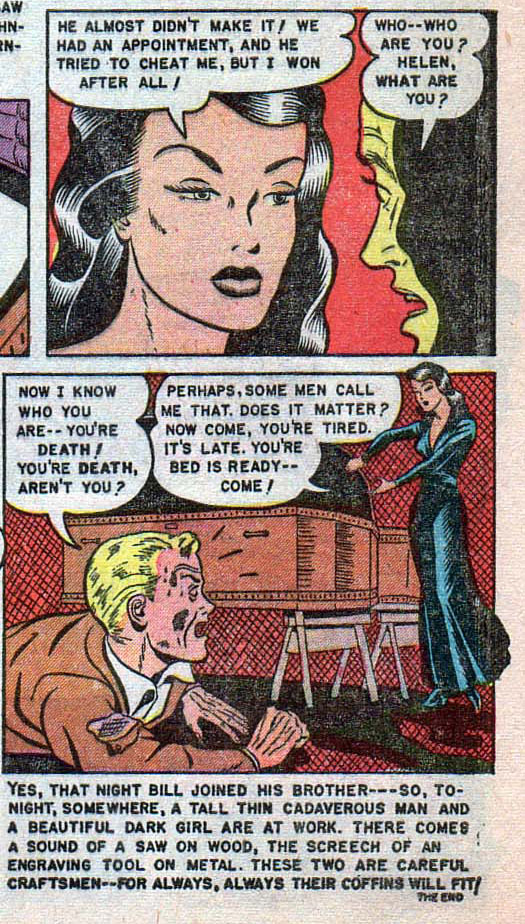
The horror comic point is a salient one, as I finally dust off and polish the actual point of this post. I was recently re-reading issue thirty-one of the excellent pre-code horror comics reprint title Haunted Horror, put out as a joint venture between Craig Yoe's Yoe Comics and publisher IDW. It somehow escaped my notice on the first read, but there was a very obvious (and hardly ignorant inclusion I have to assume) infringement in the issue of a tale from an October 1951 issue of Mysterious Adventures, titled "If The Coffin Fits...Get In!". This tale from Story Comics features two brothers–Johnny and Bill Norris–who are driving home from a funeral in a storm, when they pass a mysterious woman walking in the rain. They give her a lift, presumably just coming from the funeral herself. Her name is Helen and she lives above a curio shop with some interesting items in it, like two little novelty coffins which Johnny and Bill are inspired to purchase. Bill becomes infatuated with the strange and beautiful woman, but Johnny has his reservations. For one thing, the little novelty coffins they'd purchased seem to be growing in size each day. Bill thinks the whole thing is nonsense, but, eventually the coffins sprout silver nameplates that have their names on them, and Johnny realizes that the coffins are for them, and the mysterious Helen is actually Death!

The brothers flee town, there's a car accident, Bill finds himself at a strange shack outside of town where...you may have guessed it...Helen is waiting with the coffins.

From the April - May 1952 issue of
Dark Mysteries. Art by Tony Tallarico.
This brings us to the second tale, taken from Master Comics title Dark Mysteries, issue number six, published in April–May of the following year. The story "If The Noose Fits – Wear It!" is (almost) the exact same story! Two friends, Harry and Tod, visit a waxworks. Harry becomes intrigued by a figure of a noose-bound witch, while Tod becomes obsessed with a beautiful woman in the museum crowd. We're told the story of a woman wrongfully accused of witchcraft and subsequently hung. The noose surrounding the figure in the museum is of course the original used on the poor lady, and as a bonus, there are tiny novelty nooses for sale in the museum gift shop for collectors–made from the fibers of the original, of course!

Tod and Harry buy themselves some nooses and Tod gets friendly with Mara, the mysterious and beautiful woman he met at the waxworks. Well, as you might have guessed, the nooses begin to grow each day, sprouting tags with their names on them. Tod and Harry freak out and flee town. There's a car accident, and Tod finds himself at a shack outside of town where Mara is waiting with the nooses. Turns out Mara is actually Death!

Coincidence? I find it hard to believe. Unfortunately there isn't a whole lot of information out there (or perhaps I've been digging in the wrong dirt?) about the comics companies. Story Comics operated from 1951 through 1955, with horror, romance, war and crime comics. Master Comics published two titles: Mysterious Comics (1951-1955) and Romantic Hearts (1953-1955) which reprinted tales from the Story Comics title of the same name, so perhaps they were two publishing titles operated by the same publisher, which would explain the cannibalism. There's clearly a more-than-slightly-similar plot to the stories, with a bit about witchcraft thrown in the latter, for it to be entirely fortuitous. The design of the Helen and Mara characters are practically cookie cutter, there's a theme of floating (though differently illustrated) skulls around the margins of the panels in each, and, of course, the growing death objects seal the deal. It's hard to say what brought on the appropriation of the earlier story. It's hard to believe "If The Noose Fits..." was created out of the overwhelming popularity of the original. Perhaps Tony Tallarico (or the uncredited writer) needed ideas to meet a deadline and grabbed one of many in a then-glutted stream of horror comics and found an interesting story that he could tweak a little for his own purposes. The world may never know.

Definitely worth adding to your pull list.

Whatever the case may be, the stories are great examples of amazing pre-code horror comics and I highly recommend you seek out the issue of Haunted Horror, or, go to the wonderful The Horrors Of It All blogsite, where Mr. Karswell, the host and co-editor of Haunted Horror (and it's sister title Weird Love) posts pre-code horror comics for your enjoyment; including the two tales discussed! 

You can read "If The Noose Fits–Wear It!" here, and "If The Coffin Fits...Get In!" here!

Enjoy.