Sunday, May 27, 2018

Flying Saucers Attack Winona!

"Flying Saucers Bombard City; Alert Air Raid Warden Recovers One" reads an article from the July 11th, 1947 issue of the Winona Republican-Herald. Did UFOs really descend on my hometown one post-war summer day, darkening the bluffs with their fleet and sending the townsfolk into a panic?

No. As quickly related in this gimmicky PR piece for the Civil Air Patrol vis-a-vis Major Joseph Parks of Minneapolis, "liaison officer between the army air corps and the Minnesota Civil Air Patrol, who happened to be in Winona on business." Parks and his "aides", consisting of Lieutenant H.C. Aakre, commander of the Winona unit of the CAP, and Sgt. Robert Reynolds, army recruiter and CAP public relations officer, bombarded the city of Winona with novelty pie plates stamped 

Join The 
Civil Air Patrol
Army Recruiting Station
Post Office, Winona, Minn.

Parks clearly had tongue firmly in cheek when visiting to bolster CAP recruitment numbers. The "saucers" were taken to Parks and his aides who, after studying the alien object for a half-hour, "emerged and announced that they, too, would swear that the missile was a pie plate IF they didn't know about the 'flying saucers.'"

"We are, frankly, disturbed that our cosmic visitors are so acquainted with our pattern of life," Parks is quoted, "but we appreciate the publicity...." Clearly. The piece, puff clearly provided by Parks that rides the line between eye-rolling and damn entertaining, goes on to promote "aviation training opportunities available to youths...between 15 and 18..." to become cadets in the Air Patrol, and take what I have to assume are supervised flying lessons. "CAP instructors and members only need to pay for the gas and oil, which runs about 95 cents an hour."

Well, flying saucers must have been either in the air, or on the minds, of Americans in general–and Winonans in specific, for the purposes of this post–because tarnation if that very same issue of the Winona Republican-Herald didn't have a second saucer-centric article in it. This one from a surly Winonan who diagnoses the then-prolific saucer sightings in Blair, Wisconsin (about 45 mins NE, across the Mississippi from Winona) as hallucinations of taunting, empty dinner plates, brought on by rising food costs. Being truly Midwestern, and perhaps-not-entirely endemic to the upper portion I've spent nearly four decades in, a wisecracking auto dealer adds his 2¢ with a loaded jab about some stolen wheels. Leave it to a Minnesotan to make a tongue-in-cheek reference to his woes as a passive-aggressive way to complain about/add humor to a larger issue.


Monday, May 14, 2018

Big Noise From Winnetka!


Here is a short featuring Bob Crosby and The Bob-Cats–Bob-Cats being the used nomenclature in this short, as seen on the blackboard in the background. The group went by any of two dozen or so different spellings and names (Bob Crosby & His Bobcats, Lt. Bob Crosby and His V-Disc Bobcats, Bob Crosby & His Dixie Land Bob Cats, etc.) throughout their existence.

Bob, actually born George Robert Crosby, brother to Harry Crosby (popularly known as Bing, of course) in Spokane, WA, played with the Clark Randall Orchestra (also featuring Glenn Miller) in 1935, before splintering off and starting his Bob Crosby Orchestra and his"band-within-a-band" Dixie Land jazz group, The Bob Cats. They combined the sound of 1920s and early 30s traditional jazz with the then-popular swing music to great success, until the band dissolved in 1942. 

1933 menu for Chicago's Blackhawk restaurant, with art by Edouardé, on whom I
could find no information.
Here we don't see Mr. Crosby; rather we get bassist Bob Haggart–one of Crosby's chief composers, and drummer Ray Bauduc, co-composer of the number. "Big Noise From Winnetka" went on to be prolifically covered by the likes of Gene Krupa, the great Cozy Cole, and even Bette Middler, whatever you make of that. 

The composition was allegedly spontaneous, created from an impromptu jam session between Haggart and Bauduc at the Chicago hot spot The Blackhawk. Bob Crosby's Bob Cats recorded it in 1938 in its initial instrumental form, and again with added lyrics by Crosby and Russian-American saxophonist and composer Gil Rodin. 


The tune was played for the camera at least three times: Once in the 1941 feature Let's Make Music, which starred Crosby and was directed by Leslie Goodwins (director of The Mummy's Curse, several short subject films like Should Wives Work? and a number of Lupe Velez pictures.) There's a clip (below) here, where you see Haggart do a comical take at the beginning before the band starts in (though not playing "Big Noise From Winnetka"). 


It was featured in 1943's Reveille with Beverly, this time played by the Bob Crosby Orchestra  and Vocal Group, utilizing the later vocal version. Clip below.


The initial short that prompted this post is a 1951 Snader Telescription short produced for television play by Louis D. Snader, a SoCal theater owner who sought to diversify his portfolio by branching out into the then-burgeoning television market. He's also the guy who made similar shorts with Korla Pandit, gaining him his first national exposure. 

Promotional spread for Snader TELEscriptions.

Monday, April 23, 2018

A Glean In Their Eyes

Hello! and Welcome! Thank you for visiting the musty confines of my Secret Basement Laboratory! If you've been here before, then you know the drill–keep your eyes peeled and your hands to yourself. If this is your first visit, then, pull up a stool and don't mess with the test tubes! Ignore the sheet-draped shape on the large table in the corner...come again?...yes, yes it does look curiously like a supinely slumbering giant, doesn't it?

But never mind that!

Today I've concocted a post about something as old as time and equally as dependable. Thievery is the ugly but honest noun it goes by, but there are other, slightly-less inflammatory synonyms that could be applied, like: appropriation, purloining, infringing, borrowing...just to list a few. 
from Captain Marvel Adventures #150
(Fawcett Comics, 1953)

When someone does something that strikes a chord with an audience, big or small, there are bound to be imitators who'll strike while the proverbial iron is hot, hoping to hammer out a bit of success for themselves as well. Or, perhaps, when someone is inspired by a musician, painter, writer, what-have-you, it fails to germinate inspiration in originality beyond aping the thing that inspired them in the first place. The final tine of the purloiner's pitchfork is built for those who see something interesting but obscure, and do a pastiche in hopes that the overlooked source material won't be discovered and compared to their own.

There is, of course, the infamous twelve year lawsuit between Fawcett Comics and DC Comics (at the time National Comics Publications) claiming that Captain Marvel was an illegal infringement of Superman, that eventually led to the dissolving of Fawcett (ouch!) and DC ultimately purchasing the rights to continue to use the Fawcett characters (double ouch!). And there's the story of William Gaines's use of several of Ray Bradbury's stories for his EC Comics titles like Weird Science, Weird Fantasy and The Haunt Of Fear, among others, without crediting the author and cleverly changing the titles of the tales. For example Bradbury's tale "The Handler", from his short story collection Dark Carnival, was used as fodder for the tale "A Strange Undertaking" in the sixth issue of The Haunt Of Fear (Feb. 9th, 1951). The story was credited as being co-scripted by editor Gaines and artist/writer Al Feldstein. Of course Bradbury eventually caught on and sent the company a very tactfully worded note stating that the publisher had failed to send him remuneration for the secondary rights to his work and was sure "...this was probably overlooked in the general confusion of office work, and I look forward to your payment in the near future." 

Of course, once things were legitimized, EC began touting their Bradbury connection, reprinting the story with the proper credits. 
The original uncredited splash page for
"A Strange Undertaking" in issue 6 of The
Haunt Of Fear.
The re-titled and credited reprint of Bradbury's
"The Handler", illustrated by Graham Ingels.

From the Oct. 1951 issue of
Mysterious Adventures
. Art by Palette.
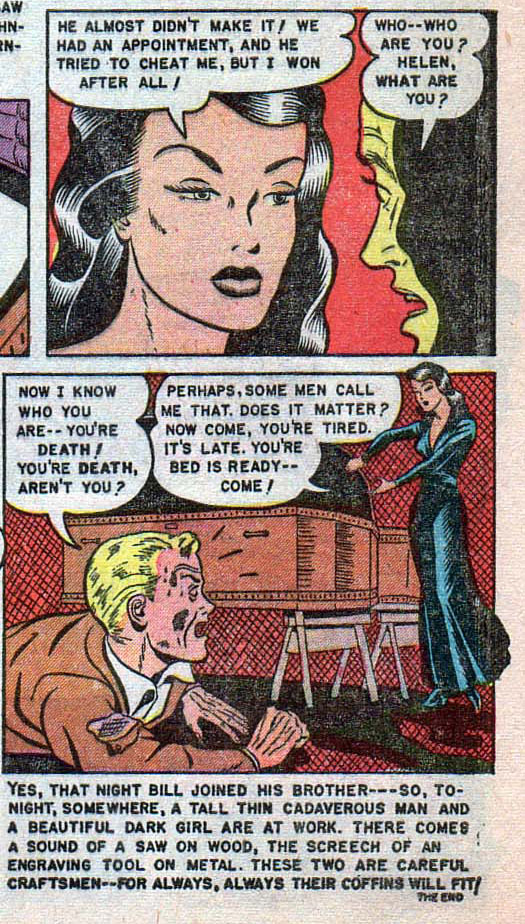
The horror comic point is a salient one, as I finally dust off and polish the actual point of this post. I was recently re-reading issue thirty-one of the excellent pre-code horror comics reprint title Haunted Horror, put out as a joint venture between Craig Yoe's Yoe Comics and publisher IDW. It somehow escaped my notice on the first read, but there was a very obvious (and hardly ignorant inclusion I have to assume) infringement in the issue of a tale from an October 1951 issue of Mysterious Adventures, titled "If The Coffin Fits...Get In!". This tale from Story Comics features two brothers–Johnny and Bill Norris–who are driving home from a funeral in a storm, when they pass a mysterious woman walking in the rain. They give her a lift, presumably just coming from the funeral herself. Her name is Helen and she lives above a curio shop with some interesting items in it, like two little novelty coffins which Johnny and Bill are inspired to purchase. Bill becomes infatuated with the strange and beautiful woman, but Johnny has his reservations. For one thing, the little novelty coffins they'd purchased seem to be growing in size each day. Bill thinks the whole thing is nonsense, but, eventually the coffins sprout silver nameplates that have their names on them, and Johnny realizes that the coffins are for them, and the mysterious Helen is actually Death!

The brothers flee town, there's a car accident, Bill finds himself at a strange shack outside of town where...you may have guessed it...Helen is waiting with the coffins.

From the April - May 1952 issue of
Dark Mysteries. Art by Tony Tallarico.
This brings us to the second tale, taken from Master Comics title Dark Mysteries, issue number six, published in April–May of the following year. The story "If The Noose Fits – Wear It!" is (almost) the exact same story! Two friends, Harry and Tod, visit a waxworks. Harry becomes intrigued by a figure of a noose-bound witch, while Tod becomes obsessed with a beautiful woman in the museum crowd. We're told the story of a woman wrongfully accused of witchcraft and subsequently hung. The noose surrounding the figure in the museum is of course the original used on the poor lady, and as a bonus, there are tiny novelty nooses for sale in the museum gift shop for collectors–made from the fibers of the original, of course!

Tod and Harry buy themselves some nooses and Tod gets friendly with Mara, the mysterious and beautiful woman he met at the waxworks. Well, as you might have guessed, the nooses begin to grow each day, sprouting tags with their names on them. Tod and Harry freak out and flee town. There's a car accident, and Tod finds himself at a shack outside of town where Mara is waiting with the nooses. Turns out Mara is actually Death!

Coincidence? I find it hard to believe. Unfortunately there isn't a whole lot of information out there (or perhaps I've been digging in the wrong dirt?) about the comics companies. Story Comics operated from 1951 through 1955, with horror, romance, war and crime comics. Master Comics published two titles: Mysterious Comics (1951-1955) and Romantic Hearts (1953-1955) which reprinted tales from the Story Comics title of the same name, so perhaps they were two publishing titles operated by the same publisher, which would explain the cannibalism. There's clearly a more-than-slightly-similar plot to the stories, with a bit about witchcraft thrown in the latter, for it to be entirely fortuitous. The design of the Helen and Mara characters are practically cookie cutter, there's a theme of floating (though differently illustrated) skulls around the margins of the panels in each, and, of course, the growing death objects seal the deal. It's hard to say what brought on the appropriation of the earlier story. It's hard to believe "If The Noose Fits..." was created out of the overwhelming popularity of the original. Perhaps Tony Tallarico (or the uncredited writer) needed ideas to meet a deadline and grabbed one of many in a then-glutted stream of horror comics and found an interesting story that he could tweak a little for his own purposes. The world may never know.

Definitely worth adding to your pull list.

Whatever the case may be, the stories are great examples of amazing pre-code horror comics and I highly recommend you seek out the issue of Haunted Horror, or, go to the wonderful The Horrors Of It All blogsite, where Mr. Karswell, the host and co-editor of Haunted Horror (and it's sister title Weird Love) posts pre-code horror comics for your enjoyment; including the two tales discussed! 

You can read "If The Noose Fits–Wear It!" here, and "If The Coffin Fits...Get In!" here!

Enjoy.

Tuesday, April 17, 2018

Secret Basement Laboratory Radio, Episode One: Private Dicks and Smart Alecks


Today I have something a little different to offer. It's a multimedia blog post featuring the standard biographical/historical thing I do here, paired with an audio offering in podcast form via Mixcloud. That way royalties will be dispensed per-play to the writers of the music used in the program (or so I'm lead to believe). 

I'm a big fan of what is now dubbed Old Time Radio. Obviously, like any medium, there's a lot to sift through, not all of it of the same quality. But when I'm lying awake nights, waiting for the veil of insomnia to part, or I am just not ready to sleep yet, I plug the earbuds of my iPod into my ears and listen to some good old-fashioned radio plays.

I first discovered the magic of OTR back in my middle school days, when I found my local hometown public library had episodes of The Shadow, packaged in what looked like those oversized vinyl videocassette cases. Since then I've grown to appreciate this artform from an era when folks actually had to pay attention to their entertainment to get something out of it. Now it seems everything is ADHD quick-cut together in music video fashion so that movies and television shows can be playing in the background while the consumer fiddles with their cell phone or plays video games. Perhaps the art of listening has taken a back burner to instant gratification and one-liner reference gags that seem popular these days vis-a-vis Family Guy and millennial comedy Netflix specials. Or, perhaps, I'm just a grumpy old man.

About The Show

Walk Softly, Peter Troy

There were, according to the scant information I could on this program, two Walk Softly, Peter Troys. One was an Australian production, and one a British production from South Africa. The Peter Troy you'll hear in this program is the latter. Sadly, as I've said, I couldn't find much in the way of information about the show. There is this page on the Times Past Old Time Radio website that features a blurb provided by someone named Pumamouse (as well as mp3 files of many of the episodes), who runs a Saint fan page full of information on The Saint radio program and the minutiae related to it. 

Walk Softly, Peter Troy is set in London, and features a very Tony Randall-sounding Troy who, in a reversal of the popular roles, seems to actually be second in command in his private investigations. His name is stenciled on the glass inset on the office door, but he's usually finding himself guided onto the right track by his doting–and sassy–secretary Julie. The show is very much cut from the Mr. Lucky cloth. The soundtrack sounds positively Mancinian, the jokes are dry and the plots could easily have been Carter Brown paperback fodder. 

It's definitely a Top Ten radio program for me. 

This show features the episode "A Flight Of Fancy", originally broadcast March 28th, 1964. It follows Troy's exploits trying to bodyguard a scientist who's developed a super jet fuel.

Richard Diamond, Private Detective


Fortunately there's a little more information on the Richard Diamond, Private Detective program, which seems to have had a long-lasting, if not somewhat convoluted shelf life. The life of a private eye, I guess. It ran from April 24, 1949, on NBC, until December of the following year. It moved to ABC radio in January of 1951, where it lasted just over five months, and then aired on CBS for a four month summer stint as a replacement for Amos 'n' Andy.

Much like Peter Troy above, the program focuses on a P.I. who is less hardboiled than your average Mike Shayne stereotype, and more prone to corny wordplay and even crooning to his girlfriend Helen at the end of each episode (played by Virginia Gregg). 

The episode I've chosen for inclusion in this particular episode of Secret Basement Laboratory Radio, titled "The Van Dyke Seance Case" originally aired September 10th, 1949. Troy is charged with revealing a sham spiritualist who is conning a Mrs. Van Dyke with phony calls from beyond the grave to ingratiate himself and his conniving partner into the lady's jewelry box.

Virginia Gregg and Dick Powell (Helen
Asher and Richard Diamond respectively)
I've chosen this episode because it's one of my personal favorites from the series, and features one of my hands-down favorite back-and-forth moments when Diamond and his girlfriend attend a seance by Professor Leonardo, the fake medium, in the guise of two hillbilly yokels. 

The Music

I've sandwiched three songs between the episodes as sort of an intermission. It beats hearing me chatter, anyway. All three were chosen because they fit the theme, atmosphere and aesthetic of the shows featured. 

All three are also from the British stock music house KPM Library. Even if you've never heard of KPM, or have the vaguest notion of what library music is, odds are you've heard a lot of the production house's music, as the NFL has licensed scores of it (pun intended) for their highlight reel production work. Many compilations even exist with titles like Music From Superbowl (insert roman numeral here), or Music From the NFL. Many of the songs, at least the first two of this trio, were also used as background music for the likes of SpongeBob Squarepants and The Ren & Stimpy Show.

The first is a track from 1965 by Laurie Johnson, titled "Blood In The Gutter." It was taken from a KPM "brownsleeve" record. A plodding drumbeat dancing with a Dragnet-esque brass section and some jazzy rolling piano. Laurie Johnson went on to score the The Avengers television series (the Steed and Peel Avengers, not the Rogers and Stark one) and Jason King, as well as the 1974 cult Hammer Studios film Captain Kronos - Vampire Hunter.

Secondly we have another NFL utilized tune called "The Unknown", by Ralph Dollimore. Dollimore was a British composer and pianist that worked with a number of the popular orchestral and big band jazz groups in London during the 1950s and 1960s (most notably, at least for me, Kenny Graham and his Afro-Cubists). His tune "Hit and Run" has been prolifically used (though uncredited, such is the fate of most stock music library musicians) in cartoons and television.

Finally, we have a man who needs no introduction in my eyes, but for the general reader, I'll go ahead and give you a little info on the amazing Syd Dale. Dale has created (subjectively speaking) some of the most amazing instrumental music I've ever heard, and is easily one of my favorite musicians, library music or otherwise. If you've seen the 1967 Spider-Man cartoon, you've heard Syd Dale. If you're a fan of niche cinema purveyors Something Weird Video, you've heard Syd Dale. The iconic music in the promo that they preface each video with is Dale's track "The Hell Raisers".

The song featured in this episode of SBLR, "Man Trap," is from the 1968 KPM album Flamboyant Themes Volume Two. Dale was a self-taught composer and musician who studied big band music while working in a chocolate factory. Eventually he started working extensively with various library houses and eventually formed his own Amphonic Sounds production company. While "The Hell Raisers" is one of his most prominently recognizable tracks, Dale has left a huge mark on the world of entertainment and advertising, largely unknown to the generations of consumers who've undoubtedly hummed some of his jingles used on the BBC or prolifically sampled by pop and hip-hop producers.

Again, I want to point out that this was a trial run. I'm working on ironing out the wrinkles, and hopefully, should an episode two drop in the future, it'll be much more polished and professionally put together than this inaugural one was.

Enjoy!
Mad Doctor Josh

Sunday, April 1, 2018

Minnesota Noirror


Minnesota: Land Of 10,000 Lakes, if you believe the official license plate tagline. Actually there are more than 10,000; I don't have an actual hard total, that isn't really the point I'm going for. When you sate your need for fantastic fiction on the kinds of material Otto Penzler compiles into his wondrously weighty tomes, you find a lot of crime fiction taking place on the misty streets of San Francisco or the cloistered concrete jungle of New York, a lot of horror and supernatural shenaniganery going on in the old attics and alleys of New England or the swamps of the Deep South, but you very rarely get any kind of action here in the Midwest. 

Particularly Minnesota.

Not a popular setting for pulp adventure or b-movie madness. If it weren't for Fredric Brown or Ray Bradbury, we wouldn't have any representation whatsoever. Of course there's always Chicago, popping up as the backdrop for a crime story or a horror tale, and I'm sure some human encyclopedia on film noir and pulp magazine minutiae could take me to task and point out some obscure so-and-so who appeared for a forgotten string of stories somewhere that was North Star State-based. Usually you get some vague, fictional small college town with a mad professor on staff at the local university  that you can kind of relate to yours in its generalities. I understand the point of great escapist material is to transport us to foreign settings that pricey plane tickets likely will not, but every once in a while it's nice to see your environment depicted as the "scene of the crime" as it were.


I honestly can't say whether the 1951 Red Scare drama The Whip Hand takes place in Minnesota or not. A cursory search online gives both Wisconsin and Minnesota as the setting, though I guess initially it was supposed to take place in New England, and feature Nazis instead of communists. The only geographical reference we have in the film itself to the location of the fictional small town of Winnoga, is about an hour in, when our intrepid New York reporter protagonist gets word out to his publisher that the place is actually running as a front for Nazi scientist Wilhelm Bucholtz and his bacteriological experiments, and the publisher in question walks over to a large wall-sized map of the United States, pokes a finger into a non-specific spot in the Upper Midwest and says "Winnoga...Winnoga...ah here it is. That puts Bucholtz and Corbin within a couple of hours drive of our Duluth office." 

Carla Balenda as Janet Keller, hostage of Bucholtz
in The Whip Hand.


The story is a fine little suspense yarn that could have easily been an episode of the Boris Karloff-hosted NBC series Thriller. Matt Corbin, a magazine reporter, is on a fishing trip in the scenic but empty town of Winnoga. A storm breaks out, reporter slips and gashes his head on a rock in the stream while wading to safety, and tries to get medical attention. The first sign of civilization he comes across is a gated driveway to a hidden estate, and is turned away by the surly gatekeeper. He then heads to the town proper to see the local doctor and finds Raymond Burr (talking in a register two steps above Perry Mason and with a talcum-grayed wig on) holding court as a hotel operator and ringleader to a bunch of unfriendly, tight-lipped locals who don't care much for nosey interlopers. Of course the young man finds out what is really going on–that the empty town is a facade run by commies servicing a Nazi scientist working on deadly bacterial agents that will wipe out the population of the United States–and tries to get word to the outside world with the help of the attractive and naive sister of the town sawbones. 

The film was based on a treatment by Roy Hamilton, who, while not having a lengthy career in Hollywood, did write a few episodes of The Adventures Of Superman and an episode of Dick Tracy, as well as contributing to the screenplay for the 1953 schlock classic Cat-Women of the Moon.  

Carla Balenda c.1955
Our protagonist was radio drama superstar and impressionist Elliott Reid (who was apparently asked to do his Kennedy for J.F.K, an impression that garnered the President's stamp of approval), who appeared in Gentlemen Prefer Blondes, a slew of television shows, and co-starred with Fred MacMurray in some mid-60s Disney films (Son of Flubber and The Absent-Minded Professor). Of course we're all familiar with Godzilla-hunting, Hamilton Burger-thwarting Raymond Burr. Incidentally, if you've not seen his bonkers Bride Of The Gorilla of the same year, I highly recommend you do, because it's amazing. At least if you have tastes similar to my own. And the connection between Bride Of The Gorilla and The Whip Hand go beyond a mere set of production dates! The Whip Hand featured uncredited screenwriting work by Curt Siodmak, the writer of films like The Wolf Man (1941), The Invisible Man Returns (1940), Frankenstein Meets The Wolf Man (1943) and...you guessed it!...Bride Of The Gorilla, which he also directed!  Our leading lady, Carla Balenda (born with the burlesque dancer-ready name Sally Bliss), doesn't have a lot of credits to her name, aside from being probably best known for her short stints as Mickey Rooney's girlfriend in the short-lived The Mickey Rooney Show (1954-55), and as little Timmy's teacher Miss Hazlit on Lassie (1958-1963).
William Cameron Menzies

The film has two director credits: William Cameron Menzies, the man who created the term "production designer" and director who directed Invaders From Mars and won the Academy Award for his production design on Gone With The Wind; and Stuart Gilmore, a noted editor who worked on films like Hatari!, The Alamo and The Andromeda Strain. Presumably Gilmore did the re-shoots that replaced the Nazis with surly Communist yokels. 

The film is available on Warner Bros. Archive Collection series, meaning you can order it and they'll burn an on-demand, professionally produced DVD-R copy of the film for you. The Archive Collection is actually pretty ingenious; it allows film buffs to get their hands on older, more obscure films that wouldn't necessarily be lucratively marketable in mass production. The films I've ordered from the collection (The Great Gildersleeve movie set, the Hollywood Legends of Horror collection) have all arrived in slick professional cases with full-color labels and production and remastering that rival any of the more mainstream releases. 

Otto Waldis as Bucholtz behind bulletproof glass, scoffing at the Feds
before being struck down by his own human guinea pigs.

Monday, March 5, 2018

Lewis Cotlow: Chronicler of Head-Hunters

Lewis Cotlow's bio from the back cover of Amazon
Head-Hunters
, Signet; 1954.
"Why does a man cut off another man's head, shrink it to the size of his fist, and then dance around it?" –Lewis Cotlow, from Amazon Head-Hunters, Signet Books, New York, 1954.

Sifting through artifacts of the past is a risky endeavor; if we look at history purely from an emotional point of view, we have a tendency to fail to actually learn from it, to objectively assess something, contextualize it, and sift the gold out of what can often appear to simply be buckets full of ugly detritus. If we weigh the scale too heavily on the side of reason, without putting things through a humanistic lens, we drop the ball of progress and fail to improve our understanding of the world and how we can improve our relation to it–and each other–in the current cultural context. After all, as the quote of muddied attribution seems to say: "Those who fail to the remember history are doomed to repeat it." The same goes with applying those lessons to the present.

For someone whose popular media consumption is largely a product of the late nineteenth and early twentieth centuries, there's a lot of dodging and pass-granting with what I read/watch/hear. Certain cultural proclivities stick out like oil spots on a white plaster wall, but that's neither here nor there. Elmer Mason Brown, H.P. Lovecraft, Donald Keyhoe, W. Somerset Maugham, Robert E. Howard,  Louis L'Amour, Edgar Wallace–the list could go on until there was no more scroll bar to the right to scroll with–all wrote great adventure tales. I certainly don't celebrate the xenophobic and misogynistic elements that pop up in their work, but that doesn't mean the stories themselves have nothing to offer. To complain about Edgar Wallace referring to a person of color as a Negro in a book from 1921 would be tantamount to complaining that Dr. Watson doesn't simply pull out a smartphone and solve crimes himself and ditch Sherlock Holmes altogether. Is it acceptable today? No. And the rational, reasonably intelligent person reading that and reacting to it would hopefully understand it without the need to demand the burning of all of Edgar Wallace's books or block a major Interstate highway in protest to point that out. 

The author's living room, adorned with a tiki from
Hawaii, a hand-carved snake from Germany, a copy
of Cotlow's Amazon Head-Hunters, and two novelty
shrunken heads.

Aside from racial and gender issues that often sully the things from this era (and while the casual window-watcher from the outside might assume that all things produced in this era contain chain-smoking white males in positions of power who consider women perfumed property and other races inferior, this is refreshingly and honestly not so, but you'd have to actually read them rather than referring to stereotypes to glean that), there's the irritating focus on affluent white males who seem to either sit around posh clubs, bragging about their latest big game kill in Africa, or spend their overabundance of inherited income and free time stomping all over some foreign culture so they can kill something from that part of the world, skin it, and bring it back to show that they've "conquered" it.

I don't agree with big game hunting. This isn't a political blog, and I don't intend to start peeling back the layers on my personal views here, but the idea of going somewhere to seek out wildlife for the sole purpose of shooting it down is abhorrent to me. Big game hunting has always been the earmark of the bored wealthy flaunting their power and stroking their egos. But, at one time, excursions by big game hunters into the unexplored regions of the world were the only insight into those strange cultures that the average "civilized" citizen had, boxed into their lives with work and home and the immediate cultural surroundings that they were familiar with, without the means to travel, save a trip to the museum or some highly fantasized piece of pulp magazine adventure.

Poster for the roadshow picture Zanzabuku (1956).
Lewis Cotlow (1898-1987) was a globe-trekker, ethnographer and cultural documentarian who could have fit into any one of the adventure tales from the early 1900s; the kind Elmer Mason Brown wrote and that eventually inspired the serials that inspired George Lucas's Indiana Jones character. He was a merchant marine who looked like actor Lex Barker, and when he wasn't working as an executive for the Massachusetts Mutual Life insurance company in New York, he traveled the world, making a name for himself making documentaries like Savage Splendor (1949), Zanzabuku (1956), Primitive Paradise (1961), Jungle Headhunters (1951, as production assistant), High Arctic (1963), and Adventures in South America (1946). These were short documentaries filmed and often put on a roadshow circuit through the United States, meaning the prints were traveled around the country, region by region, with a limited display window to entice viewers to come see this "once-in-a-lifetime" showing of a first-hand experience traveling through South America's Amazon region or through the jungles of Africa. One man's genuine cultural study is another's armchair escapism. You have to remember that this was a time without VHS or DVD technology. When you were watching a film in the theater, for all one knew, it might be the only time you'd ever have to see it.

There was a slew of "mondo" exploitation documentaries of the same nature that popped up in the 1950s and 60s, usually full of shock footage either pulled out of context or altogether staged, or with rituals often improperly credentialed as being culturally pervasive, in the vein of the repulsive Faces of Death video series that seemed to be requisite to every video store in the 1980s and 90s. These weren't Cotlow's fare. He didn't seem to be interested in shock value or misrepresentation. In fact he didn't seem to be interested in collecting ivory tusks or leopard hides, either. He does admit in his book Amazon Head-Hunters, that while traveling around to different camps, filming ritual dances and ceremonies, he'd often ask tribes to give reenactment performances if he wasn't able to capture something happening organically, so there is some artifice present but for documentation purposes, supposedly, not false customs cut from whole cloth to thrill ignorant American audiences.


Of course when seen through the lens of today, many might consider his films to be exploitative and perhaps even campy. In 2018, even the term "Savage" elicits winces. In the interest of full disclosure, I've never seen any of the films, so I'll have to reserve judgement. I've looked, and I simply can't find them to watch. But as a man granted the Explorer's Club Medal for "...extraordinary contributions directly in the field of exploration, scientific research, or to the welfare of humanity" for his decision to document the customs and cultures of tribal peoples who were likely to either vanish completely, or have their customs altered by the encroaching "enlightenment" of a shrinking globe, I find it hard to believe that Cotlow's aims were merely reputation building and personal grandeur. He was also awarded the Order of Magellan by the Circumnavigators Club in respects to "...outstanding individuals who are dedicated to advancing peace and understanding in all parts of the world."

Granted I've never met the man and I wasn't on his expeditions; and even Henry Kissinger has a string of awards and honors as long as a grocery list and seemingly oxymoronic based on his actions prior to receiving them. But one tip off to Cotlow's intentions comes in reading his book, Amazon Head-Hunters, about the Jivaro indians in Ecuador and Peru. Of course the book is covered with sensational blurbs and the title itself could come from a story found in the pages of Adam or For Men Only Magazine, but the text is refreshingly objective. Cotlow describes his trip into the South American jungles, his time spent living with the tribes in the area, and yes, it does focus on the now-taboo subject of head shrinking, but it doesn't judge or sensationalize the facts. In fact, it reads more like an archaeology text with detailed discussions between Cotlow and natives about tribal hierarchy, religious beliefs and customs and hunting strategy, than a tawdry spinner-rack paperback about lopping off heads.

Cover of paperback from author's collection.

"Nevertheless, the Jivaro is better adapted to his environment than I am, than you are. He feels more secure, despite the known and unknown dangers that surround him, than we do. He spends more hours of his life in a happy state than we do. He suffers not a whit from ulcers, cancers, diabetes, heart failure, allergies, asthma, neuroses, psychoses, inadequate housing, polluted beaches, corrupt politicians, sexual deviation, theft, murder, and war. The last two items may surprise you. But the Jivaro murders no more than our state officials murder when they execute a man for his crime." (p. 113).

Take the line about "sexual deviation" how you will. The point is Lewis Cotlow doesn't seem interested in parading these indigenous peoples as curious freaks to be gawked and snickered at by the casual civilized Caucasian; he's representing them as valid human beings with a unique culture.


Despite being largely forgotten now, Cotlow's endeavors have helped pave the way for further global cultural study. After his passing in 1987, his collection of artifacts was bequeathed to the Cincinnati Museum of Natural History (including his collection of photographs and films). To this day, a grant called The Lewis N. Cotlow Fund is available at George Washington University in Washington, D.C., where he briefly attended, for students doing anthropological fieldwork. A list of all of the projects that have been funded by the grant since 1991 can be seen here.

Sunday, February 25, 2018

A Walk On The Weiler Side - The German Animated Films of Kurt Weiler


Kurt Weiler (a screen grab from the PAL only DVD release
Kurt Weiler-Die Kunst De Puppenanimationsfilms; 2012.)
Animation seems to hold an odd place in many cultures; it's ever-present, but generally regarded as children's fare, and hardly art. More like Bazooka Joe comics: fun to look at for a bit and then discard. When I was a kid in the 1980s and early 1990s, American cartoons were more or less a vehicle for advertising action figures and sugar-based breakfast cereals (oddly enough, today's animated commercials seem to be for food or anti-depression meds, however that's to be interpreted). Of course there were the oddly calming and sleep-inducing animations that ran on PBS programs like Sesame Street and The Electric Company, but those seemed more like some kind of alien folk art than the traditional Saturday Morning cartoons and were largely forgotten or unwatched by those who had transitioned from Big Bird to the Teenage Mutant Ninja Turtles. 

There is the stigma, of course, of enjoying such things after a certain age. In my family it was a crime against the family name to continue the "immature" practice of enjoying comic books and Vincent Price films once you'd breached the double digits, when there was football and firearms to "mature" into. But, for me, animation refused to die. It kept popping back up or sneakily creeping back in to remind me it was there; in the form of Terry Gilliam's humorous psychedelic cutout sequences in reruns of Monty Python's Flying Circus, the title sequences to favorite television shows like Batman and The Wild Wild West, in the newfound Japanese Anime I was inundated with on my first trip to a Wizard World Chicago Comic Con, in the educational films shown in classrooms. Not to mention, being a child whose most prominent parent was the television set in the era of the burgeoning basic cable market, I was a huge fan of Ray Harryhausen, Willis O'Brien and, while maybe tangential, the live action foam rubber cartooniness of Godzilla and the other creatures made by Eiji Tsuburaya, by the time I was twelve. 

Kurt Weiler working on Der Apfel short.


One of the inspiring things about this troubled world we live in, is that you can find something you've been inundated with all your life interpreted through the eyes of a different culture, and have that thing reinvigorated for you. Whether it's surf music from Turkey, graphic design from Poland, candy from Japan, or in this case animation from Germany, it's nice to know that different cultures can reveal a different, previously unseen facet of something that's otherwise become reduced to wallpaper in its familiar form. It happens all of the time, the fascination with some outer-cultural phenomenon. There's a reason there's a massive rockabilly following in Japan and Europe, a soccer stadium being built down the interstate here in Minnesota, and loads of Bollywood films on Netflix. The same old can get tedious for those with interests and horizons broader than what's readily available, and there's plenty to find if one has the willingness to dig for it. 

Could someone who grew up with Kurt Weiler's stop-motion shorts really lose interest in them? Undoubtedly. I grew up with the Rankin/Bass Productions and The Muppets, and with the exception of the amazing Mad Monster Party?, neither really hold any interest for me any longer (same with said 80s and 90s licensed property cartoon powerhouses that my generation has turned into a current nostalgia cash cow). I didn't even know about Fingerbobs until Trunk Records released the soundtrack a while back, and I'm not sure I'll ever understand the appeal.  


Ein Gewisser Agathopulus (A Certain Agathopulus) 1980.

Kurt Weiler was born in Lehrte, Germany, on August 6th, 1921. His family, being Jewish, fled Germany in 1939 to escape the rise of Naziism. They settled in England, where Kurt would establish his interest in the arts, studying at the Oxford School of Arts and Crafts. By 1947 he was working for the British W.M. Larkin Studio, who produced a lot of animation for industrial shorts and educational films. One such can be seen here

In 1950 Weiler returned to what was then East Germany, and worked for DEFA (Deutsche Film Aktiengeselleschaft), an animation studio that existed from 1946 through 1990 (though I've seen sources that state 1992; anything you could possibly want to know about the political aspects of pre-unification DEFA can be found here.) And it was here that Kurt Weiler grew bored with the same-old same-old. He wanted to create something new from something commonplace. He was working under DEFA stop-motion puppet animation writer/director Johannes Hempel, who was very much rooted in the naturalistic style utilized in those Rankin/Bass productions. People puppets, though very stylized, looked very much like people. Stage sets were detailed miniatures; excruciatingly, beautifully exact reproductions of actual living spaces (see image below). 

A scene from Johannes Hempel's Der verschwundene Helm (The Missing
Helmet) 1960, gives you a taste of his naturalistic style.
Weiler wanted to loosen things up. He'd become a devotee of playwright Bertold Brecht's verfremdungseffekt (alienation effect), distancing viewers from believing what they are seeing is a slice of real life. Weiler didn't necessarily want his viewers to have to believe the characters in his animated shorts were real people, he wanted abstraction. 

In an attempt to break from tradition and start establishing his own style, Weiler left DEFA and started splitting his time between Berlin and Dresden, creating his own pieces. He was eventually rehired by DEFA in 1977, where he worked until his retirement in 1989*.


A 1958 DEFA farm equipment short RS09 animated by Kurt Weiler
still utilizing the more naturalistic look under Johannes Hempel.

This isn't an exercise in choosing one over the other. The more traditional naturalistic animations are fabulous and, in my mind, are mini masterworks of craft and artistry; but imagine if Weiler hadn't strayed from the path! We wouldn't have the mind-boggling stream-of-consciousness wonder of shorts like Der Löwe Balthazar or Der Apfel (below). Beyond that, would we have the surreal oddness of Jan Swankmajer or the Brothers Quay?

Der Löwe Balthazar (The Lion Balthazar) 1970.


Der Apfel (The Apple) 1969.

Collected below are some later period Weiler animations. Of course there are too many for me to bother to link to on this page. The loading time alone for this post would become preposterous, so I've handpicked a few personal favorites. Many of the animations are interpretations of Grimm's Fairy Tales or Aesop's Fables, with a few originals thrown in, including the middle entry in the three episode Nörgal series. 

Enjoy!


Heldensage (translated roughly to "Hero Legend") 1985
an animated interpretation of an Aesop's Fable.

Nörgel & Schonne, Teil 2 (Norgel and Sons, Part 2) 1968.


Heinrich der Verhinderte (Heinrich Prevented) 1965.


Floh im Ohr (Flea In The Ear) 1970.

*Many of the biographical details about Kurt Weiler were gleaned from "Animation: A World History: Volume II: The Birth Of A Style – The Three Markets" by Giannalberto Bendazzi; Focal Press, Nov. 2015.